
If you think there is only one Lady Liberty, Paris has three to prove you wrong.
Why there are so many copies
The statue began as a gift from France to the United States, designed by sculptor Frédéric Auguste Bartholdi with an internal framework by Gustave Eiffel, and it was dedicated in 1886. Before it was finished, its parts were shown at international exhibitions and models of various sizes were made. That habit of reproducing it never stopped: the image became a symbol of freedom, and over time cities, schools and businesses wanted a version of their own.
Some pieces now called replicas are really prototypes used during the design stage, so the line between copy and original model is blurry. If you want the monument's origin before touring its copies, begin with the history of the statue.
Paris: three ladies by the Seine
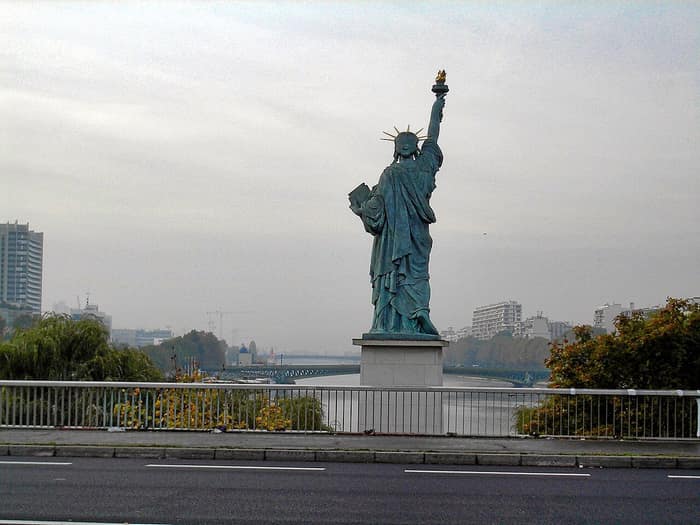
The best-known replica stands on the Île aux Cygnes, a man-made island in the Seine near the Pont de Grenelle and a short walk from the Eiffel Tower. It was given to Paris in 1889 by Parisians living in the United States, to mark the centenary of the French Revolution. It is about 11.5 metres tall, a quarter of the original's scale, and Eiffel designed its supporting structure. Its tablet carries two dates: 4 July 1776 and 14 July 1789. It first faced east toward the Eiffel Tower; in 1937 it was turned west to face New York.
Another version, 2.74 metres tall and cast in 1889, stood for years in the Luxembourg Gardens and has been inside the Musée d'Orsay since 2012, with a bronze replica taking its place. The Musée des Arts et Métiers holds the original 1878 plaster model, about 2.86 metres tall, used to build the New York statue. And in the Pont de l'Alma tunnel there is a life-size copy of the torch, the Flame of Liberty, which over the years became an informal memorial for another tragic event.

More copies in France: from the cinema to Bartholdi's hometown
Colmar, where Bartholdi was born, raised a 12-metre replica at its north entrance in 2004, on the centenary of the sculptor's death. The museum there also holds many models of different sizes that he made while designing the work. Bordeaux has a 2.5-metre statue replacing one melted down during the Second World War, and in Nice a small copy faces the Mediterranean from the seafront promenade.
The most unexpected is in Barentin, near Rouen: a 13.5-metre polyester replica built for the 1969 French film Le Cerveau. It shows how the image jumps from monument to cinema and popular culture. More trivia awaits in our Statue of Liberty curiosities page. Each one shows a different reason to copy the statue: gratitude, publicity, local pride or plain fun.
Replicas in Spain and the rest of Europe
Spain has several. In Barcelona the Rossend Arús library keeps a two-metre copy from 1894 at its entrance; in Cadaqués the oddest version stands on top of a tourist office and holds a torch in each hand; and in Cenicero (La Rioja) a small 1897 statue honours local fighters of the First Carlist War, removed in 1936 and restored in 1976.
Elsewhere there are real oddities: in Graz, a steel-beam structure shows the statue's original size before the plates were fitted; in Soltau, Germany, a theme park displays a 35-metre copy; in Lviv, Ukraine, a seated figure crowns a dome; and in Billund, the original Legoland shows a version made from around 400,000 Lego bricks. Some are pilgrimage spots for photographers and others are simple decoration, but almost all tell a local story.
The Boy Scouts story in the United States
In the United States itself there is a curious episode. In 1950 the Boy Scouts celebrated their 40th anniversary under the slogan Strengthen the Arm of Liberty. Between 1949 and 1952, scout troops bought about 200 stamped-copper replicas, around 2.6 metres tall, and donated them to different states and territories. Many were lost or destroyed, but roughly a hundred have been located in parks, town halls, libraries and schools.
Their artistic quality is debated, and one conservator said the face looks more like a girl's than the original's. Even so, they are cherished today as local heritage. If you are road-tripping through the United States, it is worth asking in small towns: there may be one near your route. Treat any figure here as approximate, since many of these statues have been moved, replaced or lost over the decades, and local sources may know more than any guidebook.
Seeing the original and the copies on one trip
If you are heading to New York, the logical move is to start with the original: plan your visit with our visiting guide and, if you want a more intimate detail, see the torch in the museum through the original torch page. Seeing it in person gives you a reference point for spotting, in any city, which copies are faithful and which take liberties.
If your route passes through Paris, set aside a little time to cross to the Île aux Cygnes or visit the Musée d'Orsay. Many of these pieces are in public spaces with variable access, so check hours, rules and current status before you go, because some have been moved, restored or temporarily closed.
Tours to see the original in New York
If reading about the copies makes you want the original, there are guided tours and cruises of different lengths and with different access. Compare what each one includes and confirm current conditions before you book.

Statue of Liberty & Ellis Island Tour with Reserved Ferry Entry
Check availability
Statue of Liberty and Ellis Island Guided Tour with Ferry
Check availability
Circle Line: New York City Statue of Liberty Super Express Cruise
Check availability
NYC City Tour: Statue of Liberty, 9/11 Memorial, Wall Street
Check availability
Statue of Liberty and New York City Skyline Sightseeing Cruise
Check availability
Statue of Liberty & NYC Skyline Cruise - Freedom Liberty Tour
Check availabilityTour titles and descriptions appear as on the booking platform. No tour guarantees a ticket or a specific experience.
See more tours and activities on GetYourGuide →Frequently asked questions
How many replicas of the Statue of Liberty are there?
Hundreds are said to exist worldwide, in many sizes and materials. There is no exact figure, because some are official, some are prototypes and others are simple decoration on buildings, parks or shops.
Which replica is the most famous?
The one on the Île aux Cygnes in Paris is among the best known. It was given in 1889 by Parisians living in the United States and stands about 11.5 metres tall, a quarter of the original scale.
Where is the original plaster model?
The 1878 plaster model used to build the statue is kept at the Musée des Arts et Métiers in Paris. It is about 2.86 metres tall and reached the museum through a bequest from the sculptor's widow.
Is there a replica that has appeared in films?
Yes. In Barentin, France, a 13.5-metre polyester replica was built for the 1969 film Le Cerveau. The one on the Île aux Cygnes also appears in a 2007 film.
Are there replicas in Spain?
Yes, several: an 1894 one at the Rossend Arús library in Barcelona, a peculiar two-torch version in Cadaqués and another from 1897 in Cenicero. Check current access before you visit.
Are all the copies official?
No. Some are gifts or models by the sculptor himself, others are later copies, and many are decorations with no link to the national monument. That is why it is best to use the word replica loosely.
Can I always visit the replicas?
Not necessarily. Many are in public spaces, but others sit inside museums, private buildings or parks with opening hours. Conditions change, so check access and status before planning.
Keep reading
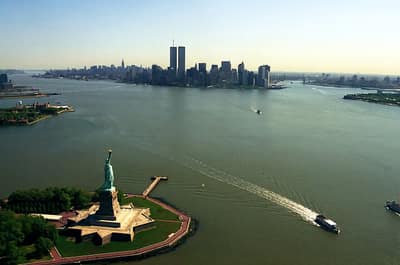
New York helicopter tour over the Statue of Liberty
From the air, the torch sits below eye level and the whole city looks like a scale model.
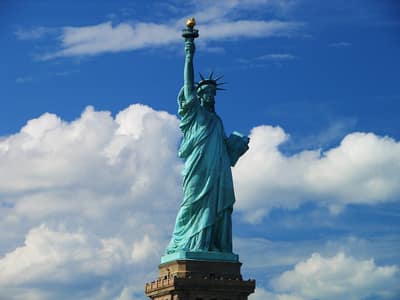
Statue of Liberty frequently asked questions
One part of the Statue has been closed to the public for over a century, and it is not the crown.

Statue of Liberty pedestal and museum
Under the statue lies a star-shaped fort that hardly anyone notices.
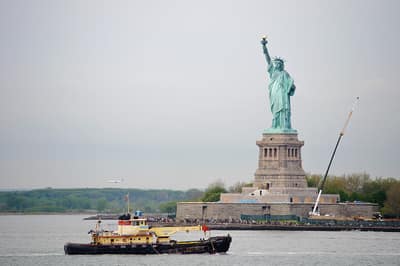
Statue of Liberty with kids: a family guide
To a child the statue is a green giant; the trick is how you tell her story.
Sources
Facts taken from Wikipedia and the U.S. National Park Service (public domain). Always verify practical information on the official websites.
Photo credits
- Guilhem Vellut from Paris, France, Wikimedia Commons, CC BY 2.0
- Guilhem Vellut from Paris, France, Wikimedia Commons, CC BY 2.0
- VillageHero from Ulm, Germany, Wikimedia Commons, CC BY-SA 2.0